
The ins and outs of pre-reading

In a recent student meeting with one of my college students, we focused our time on preparing for a writing assignment (write a rhetorical essay) based on an assigned reading (a case study about a woman who was terminated from her job after posting a disparaging remark on social media). 

Many times, such as this one, starting an assignment can be tricky and can even seem insurmountable.  Our materials or our thoughts may be disorganized, we might find the assignment unclear, or our motivation may be stalled.  Whatever the case, pre-reading a reading assignment and breaking down the task at hand can be a great starting point to accomplishing your task!

So, we rolled up our sleeves, pulled up the case study, and got to work.  Here are the steps we followed:

  • Organize your materials:
    • Are you a pen and paper type of person, or do you prefer to read from a screen?  Match your materials to your preferences and set up your space accordingly.  Pull up your reading passage + writing assignment so that they are within an arm’s reach.
    • Has your professor provided a writing prompt?  Are there specific questions to answer?  Highlight these questions, create an outline, and copy/paste these questions right into that outline.
  • Review the questions provided:
    • Are they straightforward?  Are any of them unclear?  Are there questions you’d like to add?  Write them down, too.
  • Pretend you’re an athlete and do some warm-up:  
    • Check out the title.  What do you already know about this topic?  For this student, case studies were a new type of reading.  
    • Take a moment to think about the reading’s structure and do some quick research.  Some questions we asked were:
      • What is a case study?  
      • What can I learn from this paper to guide my writing?  
      • Why does my professor think this is an important piece to read and write about?   
  • Make friends with the abstract or introduction + conclusion
    • What information do they provide?  
    • Are there questions or points they highlight, such as key findings?
    • Can you add any of this information to your outline?
  • Review each of the headings:
    • Create questions from these headings.  You can use these questions to guide your closer reading.
    • How do these headings connect with the questions posed by your professor?  Is there information you can add to your working outline?
  • Dive into the reading itself
    • Work to answer the questions that your professor has raised and pull out key points you’ve recognized, which you can use in your paper. 
    • Add these findings, along with page numbers for easy citations, to your outline.

Investing the time in pre-reading can feel unnecessary, but it will save you time in the end.  You’ll be able to identify key points more easily, because you have primed your brain to take in this information.  And, because you’ve taken the time to connect this information with your prior knowledge, you will be able to access the details more readily during the writing process and in future class discussion. 

Do you have questions about creating effective and individualized reading strategies?  Please reach out to schedule a consultation at danaroseroth at gmail dot com.

Learn more and stand out when you can’t connect with colleges in person

NCSA: An athlete's guide to taking a college tour entirely online

In a recent webinar with admission representatives from across the country, I heard from directors and deans of admission from a variety of colleges and universities who shared that they will not be making their usual fall school visits in light of COVID-19.  While this is, of course, both unsurprising and disappointing for rising seniors who may have been looking forward to connecting with admission counselors at their schools, we can think about this as a new opportunity to be creative in learning more about a school and showcasing yourself and your strengths to admission representatives. Here are some ideas to get a jumpstart!

Connect on social media: 

Many schools enlist their current students to run their social media accounts.  This way, prospective students are getting an insider’s perspective of the school, rather than learning about it from an administrator.  Are you already following the schools where you’re applying on social?  If not, take a few minutes to seek out the accounts and add them to your feed.

Parents: this can work well for you, too, as it’s a great way to glean insight about schools in which your student has expressed interest!

Embrace the live-virtual sessions: 

As colleges continue to grow their virtual offerings, many are providing live-virtual programs, as we covered in my recent blog post.  Check out schools’ websites for updated opportunities, find a date and time that work for your schedule, and tune in.  Not only will this be another way to hear from current students and demonstrate your interest to each school, but also you will enter your contact information before participating in these programs, providing another great point of contact for the schools to track.

Virtual college fairs:

This fall, instead of attending college fairs in person, admission reps will be tabling in a virtual space. 

Are you a rising junior?  This will be ideal for you to begin your relationship with a variety of schools and start to learn more about their academic programs, student resources, athletics, student organizations, and more. 

Are you a rising senior who hasn’t yet connected with a representative from a school you’re considering?  Drop in for a quick chat and communicate your interest and/or ask the questions you’ve been sitting on this summer. Learn more and register for a virtual college fair, such as the NACAC National College Fair, which will be held on various dates this fall.

Connect “in-person:” 

Oftentimes, colleges and universities will organize their admission staff website by territory, because at many schools, admission representatives are each assigned to recruit and review applications from a distinct travel territory.  This may consist of different cities and towns within a state, multiple states, multiple countries, or a combination of all three.  Colleges and universities encourage prospective students to reach out to their assigned admission representatives in order to put a name with a face.

Feel free to reach out to your assigned rep with questions about the school that you can’t answer easily on the website, to let them know you hope to be in the area on a given date (when travel is an option again), or to seek out their help in connecting with various professors of interest.  This is yet another way to show your demonstrated and genuine interest in a school!

Do you have questions about ways to make the most of your search and stand out from afar? I’d love to chat!  Please reach out to schedule a consultation: danaroseroth at gmail dot com.

Executive Function and Your Brain’s CEO: What is EF and how can coaching help?

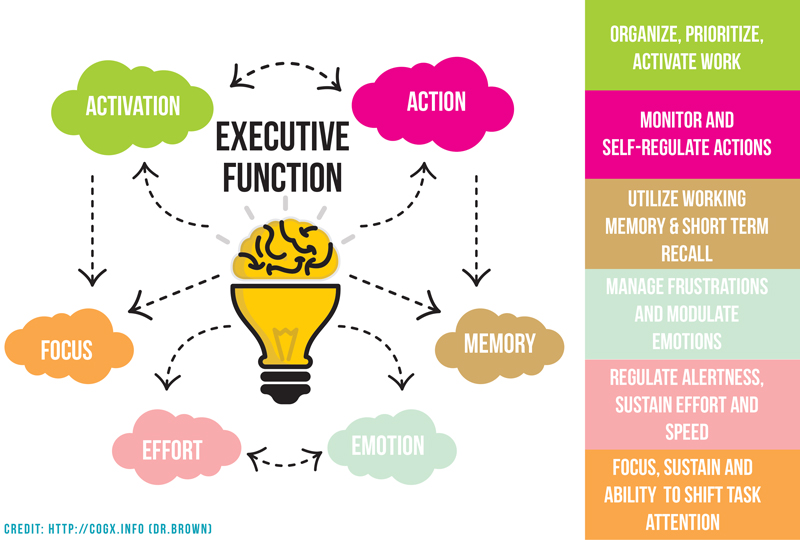
A lot of the work I do focuses, of course, on executive function.  But what happens when someone doesn’t know what this term means?  At best, our work becomes less effective, but at worst, it can mean we might not get the help we need.  Let’s take some time to discuss this term and think about why it matters.

A great analogy for “executive function” is that together, the parts of your brain (most notably, the frontal lobes) responsible for executive functions operate as the CEO.  If we think about an effective CEO of an organization, we think about their ability to organize themselves, remember important information, self-monitor and self-regulate their behavior to strengthen their interpersonal interactions, focus on tasks for a prolonged period of time, and shift between tasks flexibly

Most likely, a CEO didn’t become CEO overnight.  Instead, we can guess that they committed themselves to their work over a long period of time, and learned or created strategies to help them succeed.  This is precisely where executive function coaching comes in!  For many of us, creating a plan, setting goals, managing our time, regulating our emotions, and flexibly shifting between tasks can be challenging.  For those of us with a learning disability or ADHD, the difficulty can increase even more.

Working together, we can identify areas of strength (sense of humor, creativity, empathy, love of reading, athleticism) and consider how to create strategies that use these strengths to bolster areas of difficulty (organizing materials, prioritizing tasks, identifying how long assignments will take, managing time).  Let’s work together to make you a stronger learner, so that you can let your strengths shine!

Do you have questions about strategies to start your year off on the right foot? Please reach out to schedule a consultation at danaroseroth at gmail dot com.
College Visits from Your Couch: Which type of visit is best for you?

What a time to be college searching!  Perhaps you had your college visits lined up for April vacation, only to have to put the kibosh on them due to COVID-19 lockdowns.  Perhaps you’re still thinking about possible schools to add to your college list for this fall.  Or, maybe you’re a rising junior who’s trying to get a head start on the search process.  No matter the hypothetical scenario, learning more about the potential colleges on your list from the comfort of your home can be a welcome opportunity.  Let’s think through how to make the most of this time.

The completely virtual visit:

Prior to COVID-19, many schools offered a virtual tour of their campus, sometimes called a 360 tour.   Especially in our current climate, a virtual tour is a great way to get the lay of the land and learn about the different functions of the buildings on campus.  For example, you may see where a campus center is located on campus and how it houses student organizations, a dining hall, and various student affairs offices such as community service, residence life, and disability resources.

What are the best parts of a completely virtual visit?

These tours often allow you to view a campus map, orient yourself to campus, select buildings to explore, and envision yourself in these places and spaces.  

Virtual visits can be a great entryway to sparking questions about each school.  For example, how far are classroom buildings from residence halls?  Do some residence halls have dining halls in them?  Are you hoping to play a sport in college?  If so, are playing fields on campus, or would you take a shuttle to get there to practice?

How can you access a virtual tour?

You can typically access the virtual tour easily by going to the Undergraduate Admission page on a school’s website, and selecting the “Visit” option.  You’ll likely see the “virtual tour” option clearly listed on this page. If not, you can search the school’s website for the virtual tour.

The live virtual visit:

For most schools offering a live virtual visit, this is a new post-COVID-19 opportunity, and allows for a real-time visit from the comfort of your home.  Many schools are now providing this option, connecting prospective students to both a current student tour guide for an abbreviated campus tour and to an admission representative for an information session.  

What are the best parts of a live virtual visit?

During each session, students and families will be able to ask questions in real time, and learn from questions that others raise, just as you would during a more typical, on-campus visit.  

Having interaction with current students allows you to ask real questions and receive genuine answers.

Live virtual visits are a great way to learn more about schools that are farther away from home, as you are less likely to travel to campus right now.

How can you access a live virtual tour?

Head to the school’s website to schedule this “visit,” as schools are limiting participants in each group in order to create a more personal atmosphere.  

The in-person, socially distanced visit:

While most schools are limiting their exploration to a virtual experience, some schools are providing private, socially-distanced student-led tours and/or meetings with an admission counselor.  

What are the best parts of an in-person, socially distanced visit?

Visiting a school in this way will allow you to see the buildings and campus up close and personal and get a closer peak at the surrounding area, shops, and restaurants.  

If you haven’t yet started your college visits, you can work to pinpoint schools of interest in your local area.  Starting your visits there will help to spark questions for you to incorporate into your virtual visits, as well!

How can you access a socially distanced in-person tour?

Students and families will need to visit a school’s website to schedule this in advance, and will need to follow each school’s protocol.  For example, most schools offering this experience are requiring students and families to maintain 6 feet of distance and wear masks.

Do you have questions about ways to prepare for and make the most of these visits?  I’d love to chat!  Please reach out to schedule a consultation: danaroseroth at gmail dot com.

Welcome!

Thank you for visiting Dana Roth Educational Consulting.  I love working with students in middle school, high school, college, and professional programs to connect them with strategies to succeed.

I provide executive function coaching and college counseling services to students with and without learning disabilities, and I especially enjoy working with students and families to learn the ways to be most supportive in a student’s academic journey.

I hope you will explore my website to learn more about ways for us to work together. I look forward to connecting with you soon!