
- A big part of the college exploration process includes a consideration of the majors you’re most interested in. Perhaps you already have a clear idea of what you’re seeking. Perhaps you know the subjects where you excel but you’re not sure how you can build your interests in college. No matter what, learning more about these areas can be hugely helpful in reinforcing your interests and identifying new ones. Here’s where this website comes in!
- What Can I Do With This Major?
- As the name suggests, this website explains 100 majors in-depth and provides possible outcomes from the various majors.
- Please spend time identifying 2-3 majors of interest and some career paths that sound interesting to you.
- Are they similar or different from what you’d expected?
- What sounds most interesting about these majors?
- Please jot these ideas down to discuss later.
Early apps are in! Now what?
Congratulations for submitting your early applications! Perhaps you even have some rolling decisions coming back and you’re already feeling great. What happens next?
Update your portal for each school’s application
- Spend the time to make sure each school has received all of the materials that they need in order to review your application by their deadlines.
- In the event that any materials are missing, connect with your teachers, guidance counselors, or ACT/College Board, to confirm they have submitted your credentials. Log back into the portal to double-check.
- This not only ensures that schools have received your materials, but also allows you to continue to demonstrate your interest, something colleges will continue to track.
Give yourself a short break
- Use your time to make sure that you are up-to-date on all of your school assignments, connect with teachers to share your progress, and give yourself some downtime. You’ve earned it!
Jump back in and finalize your Regular Decision applications
- I always recommend that you complete your regular decision applications before the middle of December, even if you were pretty certain that you will be admitted to at least one of your early schools.
- Why is this? You’ll want to frame your remaining essays in the best possible light!
- A great way to do that is to write your supplemental essays (and review them with a trusted advisor) before you have received any news that you didn’t expect, which might put you in a negative mindset. This will ensure that you are putting your best foot forward on your regular decision applications, and even better, you’ll complete all of your materials and have them ready to submit ahead of winter break, allowing you to truly take a break and enjoy your time off!
Are you or your high school student seeking support in the college search and application process? I’d love to connect and learn how I can help! Please reach out to danaroseroth@gmail.com to schedule a complimentary 30-minute consultation.
To disclose or not to disclose?
Recently, I had the great opportunity to speak with a group of local families about the transition to college and best practices for student success. I always love connecting with students and parents and educating them on the ins and outs of college life, and this was a fantastic reminder that even though we may be apart physically, we can still come together virtually and discuss this important topic!
One question that many families had is, “should my student disclose their disability diagnosis in the college application process?” My (perhaps unsatisfying) answer was, “sometimes!”
The reason for this answer, of course, is that this is a deeply personal question and requires some in-depth thinking to decide whether it’s a good option for you. Let’s think through some of the reasons a student may wish to share a diagnosis during their application process:
- Some students will share their diagnosis in their personal essay, perhaps around the impact it has had on them, adversity they’ve overcome, or special or unique characteristics or strengths that may be connected to their disability.
- Other students may share their diagnosis in an application’s optional additional information question, which can be a more straightforward statement. Sometimes, students might explain an upward trajectory in grades, perhaps due to learning more about oneself and better use of accommodations over time.
- Other students may choose to disclose a diagnosis during an interview with an admission representative, perhaps as part of a question about disability services and other resources on campus.
- Finally, some students may simply choose not to disclose anything until after being admitted and enrolling at a school. All of these options are absolutely fine and depend on the student’s preference and needs.
Whether a student chooses to disclose or not, there is loads of information that students and families can learn on each college’s disability services website. I always encourage students to review this office’s information to learn more about the college’s approach to working with students with disabilities.
Perhaps most important to know: at no time in the application process should a disclosure of a disability have an adverse effect on a student’s application. This would be a violation of the Americans with Disabilities Act Amendments Act of 2008.
No matter a student’s decision to disclose during the application process, it will be important for students to self-disclose once they have decided on a school, in order to ensure that they request and receive reasonable accommodations.
Are you or your high school student seeking support in the college search and application process? I’d love to connect and learn how I can help! Please reach out to danaroseroth@gmail.com to schedule a complimentary 30-minute consultation.
Help! My dream school deferred me…what do I do?
We’ve come to a tricky part of the admission process. Some seniors are seeing their friends receive acceptances while still waiting for their own to arrive. Others have received the news that they’ve been deferred from their top school and are uncertain what that means and what to do next.
Deferrals can be rough in any year, but certainly in our current climate. Give yourself the time and space to check in with yourself, wallow a bit, and come to terms with this decision. It is HARD, but you will come out even stronger on the other side! After giving yourself some time to grieve, make a plan with steps including the following:
- Reach out to your admission counselor to learn more about their early action or early decision process this year. If you don’t know your admission counselor’s name, refer to the school’s admission page and look for a “find my counselor” link. Make sure to ask:
- Were many students deferred?
- Are there certain criteria the school is looking for in later stages of the admission process?
- Do you need to formally accept the deferral decision? If so, make sure to complete any necessary paperwork (electronic or hard copy) within the school’s deadline.
- Continue to demonstrate your interest to the school.
- Due to COVID precautions and travel limitations, it may be best to sit tight and show your commitment from home, rather than traveling to campus. Check out the school’s website to learn about their virtual information sessions. Schedule the ones that work for you and ask questions to continue to convey your interest. Be sure to send a follow-up thank you email to the presenter.
- Continue to stay in touch with your admission counselor. Have you pursued a new interest? Begun working in a new job? Did you land a new leadership role in one of your extracurriculars? This is great information to share, and they want to hear from you!
- Revisit your college list.
- Connect with your college or guidance counselor to talk through your current list.
- Have you put other schools on the back burner and need to return to them now?
- Do schools need to be added to round things out?
- Is there more outreach you can do to show interest at other schools?
- Take some time to reevaluate and make sure you are setting yourself up for success in the months ahead.
- Connect with your college or guidance counselor to talk through your current list.
- Focus on you!
- Though it’s tempting to let the senior slide start now, this is a great time to continue to build on your successes and let your hard work do the talking.
- All of the schools to which you’re applying will want to see continued effort and strong grades, and your top choice school is no exception!
- Keep up the good work if you are already on an upward trend, and put in some extra effort in areas where you may be less confident. Make sure that your high school sends updated grades when they become available.
- Connect with your teachers!
- Have you especially enjoyed one of your senior classes? Could that teacher speak to your commitment in a certain discipline or highlight a new facet of your application? Consider asking them to write a letter of recommendation on your behalf, which you can submit to your admission counselor.
- Finally, don’t be afraid to ask for help!
- Let your parents, siblings, or friends know you’re having a hard time and see how they can help cheer you up and encourage you along!
Are you looking for some extra support as you come into the home stretch of applications? Reach out to schedule a 30-minute complimentary consultation at danaroseroth at gmail dot com.
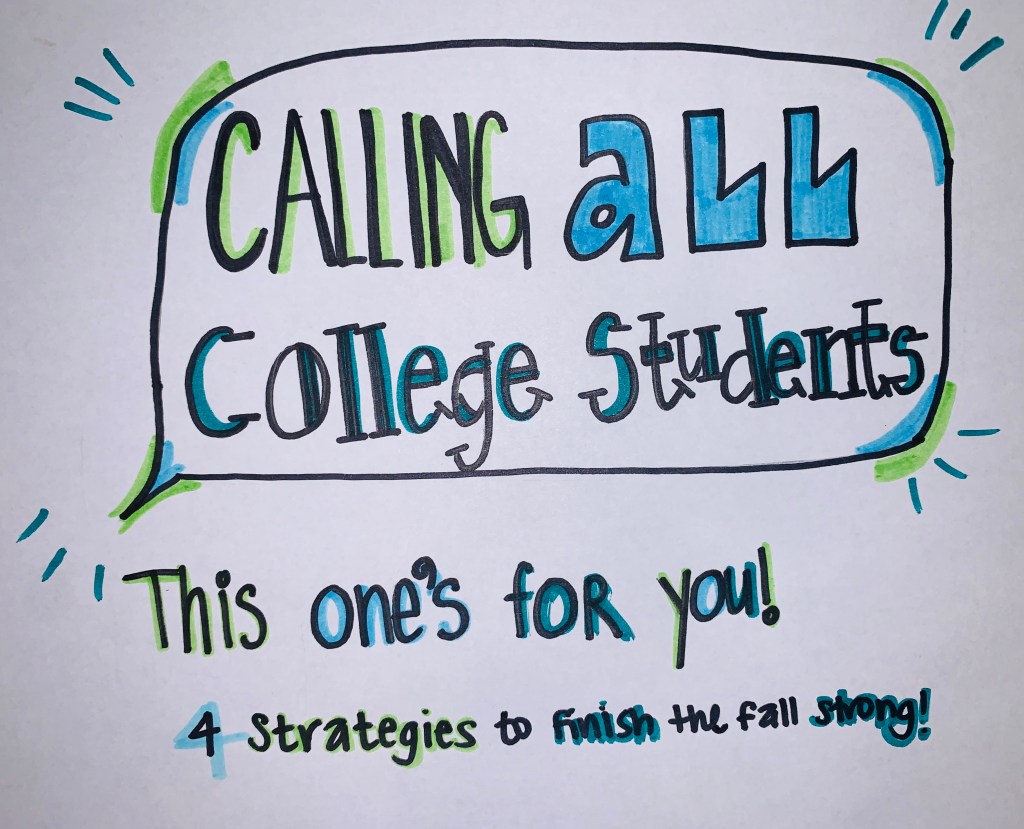
Finish your Fall semester strong with these 4 strategies!
This has been a fall semester like none other. We’ve all been doing our best to simply make it work in the midst of a global pandemic. This is no easy task! Perhaps you’re back at school taking in-person classes this semester, or maybe you’re taking classes from the comfort of your childhood bedroom. No matter your location, here are four recommendations to help finish off strong!
#1. Applaud yourself!
You have spent the last two months (or more!) balancing schoolwork with your physical and mental health and safety, and you’ve had to adjust expectations, routines, and living situations along the way. This is quite the undertaking. Give yourself a pat on the back, air high five a friend, enjoy an ice cream sundae, or find another reward to celebrate this not-so-small victory!
#2. Take a tally
What has gone well this semester? Where have you struggled? Are you pouring all of your time and energy into two classes, while the other two or three have fallen to the wayside? Has one type of assignment gone well, while others have been trickier? What has class participation looked like this semester? Are your classes remote, in-person, or a combination? Are you a “chatty Kathy” for your in-person or synchronous classes, but you’re struggling to keep up with written discussion posts? Give yourself time to reflect on your successes and on your struggles.
#3. Make a plan
Great job identifying what’s going well and where you may feel confused! Now to finish on a high note! How do you typically manage your time? Do you keep a spiral-bound paper planner? Is iCal your BFF? Maybe you love your monthly desk calendar. No matter your preference, let’s put your preferred method to work to get the most out of it.
Start out by adding each assignment deadline (large and small) to your calendar of choice.
Think: “Is this a large or small priority for me?” AND “how much time do I need to complete this task well?”
Set a timeline: How far in advance would you like to begin different long-term assignments? How long do your smaller, daily tasks take you to complete? What are the times of day when you are most productive, and which tasks can you complete during these times? Making your time visual can help keep you on track, complete assignments ahead of time, and feel a great sense of accomplishment because you can easily monitor your progress!
#4. Use your resources
With your plan in place, it’s time to get answers to any lingering questions.
Is an upcoming assignment or exam tripping you up?
Check out your syllabus to find your instructor’s or TA’s office hours. Make a point to attend (even if it’s over Zoom) or to schedule a separate meeting if need be. Having your questions answered will allow you to dive into your work much more quickly! And even more, you’ll demonstrate your commitment to the class to your professor. Definitely a win-win!
Do you have a long-term paper coming up?
Connect with a research librarian on campus (or over Zoom!) to get a head start on your research. They can help to narrow your focus, zero in on the best peer-reviewed journals for your topic, and request books through inter-library loan, helping you to make the most of your time.
Check out your school’s Writing Center and make an appointment with a writing tutor. They can help with anything from brainstorming and outlining, to thesis development, to selecting quotes, to reviewing citations, and more.
Are exams a sticking point for you?
Check out campus tutoring opportunities, form a study group with friends, or head to Khan Academy for online tutorials, to make sure up to speed on the course content.
Do you have more specific questions about how best to utilize your time, break down assignments, prepare for exams, and more? Let’s connect! Email me at danaroseroth at gmail dot com and let’s chat!
What does a DIY project have to do with executive function coaching?
A topic I often focus on with students is project management, or how to break down a project into smaller, manageable pieces and set a corresponding timeline. Creating bite-sized tasks can make anything seem more approachable, and a good ole DIY project is no different.

I’ve known I wanted to repaint this desk for my new kindergartener for weeks, and I had looked forward to it all summer. But until I broke down the task, it seemed surprisingly insurmountable. It turns out that small steps and a concrete timeline were exactly what I needed!
- Have my 5 year-old select her paint color
- Purchase paint and supplies
- Clean the desk
- Apply the first coat of paint (and embrace its imperfections)
- Apply the second coat of paint
- Apply the wax coat to seal the paint
- Find the right sized stool she’ll need to prop up her feet, helping to ground her and support her core
- Stand back and admire our handiwork

It’s easy to get wrapped up in the feeling that a project is too big to handle. For example, though I’ve done DIY projects before, I haven’t given myself the same tight timeline (5 days from the time we purchased the supplies until the first day of remote school). When we step back, determine a timeline, and break the task down, it becomes much easier to get to work.

What would I do differently in the future?
- Start earlier
- Even an executive function coach procrastinates from time to time. Making the time for self-reflection (even when it’s to give ourselves some gentle feedback) is an important step for growth and continued improvement.
- Embrace the awkward first draft
- We knew that the first coat of paint was only a rough draft. Giving ourselves the space to be OK with that knowledge was crucial.
- Have a bit more faith in my partner
- My young daughter was my right-hand-woman in this adventure, and she proved to be much more capable than I’d realized. Taking a moment to recognize strengths in a group member or in ourselves is so important, as it allows us to place more trust in that person and be more confident in the work they (or we) are doing.
- Over-estimate the amount of time each task will take
- This is a tricky one, as we may not have a clear understanding of how long an assignment will take. Giving ourselves some extra time is always a win! If you end up finishing a step earlier than expected, you have found a few extra minutes in your day.
Do you have a looming deadline you’d like to talk through? I’d love to connect about strategies that might work for you and how to make them realistic for your needs! Please feel free to send an email to danaroseroth at gmail dot com to schedule a complimentary 30-minute consultation!
Wishing you and your students a great start to the school year!
Senior Summer Send-Off #4 with Anna
To round out our Senior Summer Send-offs, we hear the experience and perspective of a recent graduate who made the decision to take a gap year. Anna has deferred from Stanford University, and she’s excited to travel to Ireland this fall. I hope you’ll find her insight as interesting as I have!
Let’s dive in and talk about your decision to take a gap year. What motivated this choice?
“Taking a gap year was never anything I had considered. I love a plan, and I had planned for high school, then college, then grad school. In early June, I got an email for school outlining their plan and it wasn’t anything I realistically wanted. They were only having two classes on campus per quarter, and they didn’t say which classes would be there at which time. A big part of what I was excited about were the people and the activities of the full college experience, and I decided to pull the plug. I applied for a bunch of gap year programs, which felt like the college application process all over again.
“I will be traveling through Irish Gap Year for three months this fall. I’ll live in a town called Donegal, on the Northern coast. This program seemed like it had the highest likelihood of running [despite COVID]. I really liked the [administrators] I spoke with, and it sounded like a really good fit. I’ll come home at the end of November, when I’ll be able to see my friends, who will be home on winter break. I’m not sure what the spring will look like right now, and I’m keeping my options open.
“I will be participating in the adventure and leadership program, which has a lot of hiking and kayaking paired with a lot of community service. One of the things I will be doing is teaching surf lessons for kids with disabilities, which is a really perfect fit for me [due to my interest in working with students with disabilities]. There will also be a lot of cultural immersion stuff, and the program will give us space to be college students. I’m living with 15 kids. I’m going in blindly, but that’s sort of what a traditional college experience is.”
Why did you choose Stanford?
“My dad went to Stanford, and he took me to visit when I was 5. I was like, ‘I love it here, I have to go!’ [which continued through middle school.] In high school, I was like, ‘no one gets into Stanford,’ so I let it go. I started thinking more realistically about [a range of] schools in the Midwest and on the West Coast. I applied early to Stanford and figured why not. When I opened my letter and it said congrats, it was obviously really exciting, but after I got in, I realized this was it! It ended up working out! I am definitely intimidated by the students and the environment, but this wasn’t something I was going to turn down. It’s definitely going to take some time to adapt and adjust.”
What is your intended major?
“I am undecided to the max! When I went on college tours with my parents, and the tour guide would ask where you’re from and what you’d like to major in, everyone seemed to have everything, such as majors, minors, and research topics, all planned out. After applying to college and experiencing the process, I’ve realized I was actually reasonable throughout [by not landing on a specific major in advance].”
What are you most excited for in the two years ahead?
“For both my gap year and for Stanford, I’m most excited to meet new people, immerse myself in a new environment, meet new friends, and make new connections. I’m kind of looking at it like I’m going to overnight camp [which I did for 9 summers].”
What are you most nervous about?
“I think my answer is the same. I’m nervous about meeting new people. It’s a mix of being excited and being nervous. Obviously it’s a little intimidating when you’re somewhere new with no one you’ve ever met.”
Have you connected with your roommate or other students on campus?
“I met one person, who lives in New York, earlier in the spring. She ended up being in town one day, so I drove up and had lunch with her, and we’ve been in contact ever since. She ended up taking a gap year too, so it’s been really nice to have someone else in the same boat as me. I think we were both pleasantly surprised to find someone who we found a connection with so easily. Now, we’re both in the class of 2025.”
What advice would you give to students going through the application process now?
“Take a deep breath and then buy a calendar and make a schedule for yourself. That was definitely something that made a huge difference–trying to stay organized and on top of due dates. I got a huge desk calendar, and laid out different deadlines like, ‘finish my essay by this date,’ and ‘finish my applications by this date.’ I had friends who didn’t do that and had a harder time.
“It was a very stressful time for me, and I had to recognize that my parents only wanted to help me out. Allow your parents to support you. Don’t push them away. I definitely had a lot of times when I was like, ‘I need to deal with this on my own,’ but definitely allow support from your parents and your friends. It’s really easy to get in your own head and want to do everything yourself, but try to open yourself to your parents and friends; your friends are going through the same thing.
“Also, when I wrote the first draft of my essay, I was like, ‘that was horrible!’ and I shut off the computer and was like, ‘I’m done!’ But then I realized this was definitely only the first draft of my essay. You have to re-read and edit your essay until you’re dreaming about it. You really have to keep working on it more than you ever have in your life.”
Throughout these interviews, it has been so affirming to see that what students are equally looking forward to and nervous about is connecting with others in their new homes. It’s exciting to think about all that they have ahead of them and the many opportunities they will encounter in the months and years to come.
Thank you so much for sharing about your decision to defer at Stanford and about your upcoming gap year, Anna. Wishing you a wonderful trip to Ireland this fall!
Do you have questions about the college application process and finding the best schools for you or your student? Send an email to danaroseroth at gmail dot com to set up a complimentary 30-minute consultation!
Senior Summer Send-Off #3 with Isaac
Isaac may be new to New Orleans, but between online summer coursework and an early move-in at Tulane University, he is well on his way! Read on for Isaac’s recommendations for a successful transition to college and his reasons for choosing Tulane.
How did you spend this summer?
“Once my camp was canceled for the summer, I knew I needed something else to do. This was the best summer to take some classes and get ahead, especially since I want to do a double minor and take classes in a fourth subject. I decided to take Microeconomics and Psychology online through Tulane this summer. My Econ class meet three times per week, and my Psych class met once per week. Taking these classes ahead of time allowed me to feel more confident and helped me to figure out a bunch of good study skills. I also worked with a Success Coach throughout my summer courses, and I’ll meet with them again to help plan for the fall semester.”
In light of COVID this fall, what will the structure at Tulane look like?
“I’m really grateful that I’m able to do a lot this semester. All of my classes are in-person. Tulane built a bunch of temporary classrooms that are really large, have air conditioning, and can seat 60-80 students with social distancing. They’ve also moved smaller classes to bigger rooms to accommodate social distancing, and they’re utilizing different spaces like the art museum, admission halls, and the basketball stadium, where they haven’t done that in the past. The University made it their goal in early April to have in-person classes and to have roommates, and they really invested and were able to deliver. They’ve also built a new dining pavilion and [put different restrictions in place] like having the gym be appointment only.”
Why did you choose Tulane?
“I felt like Tulane was the right school for me in terms of fit; I totally saw myself here. I toured two years ago and it just felt like home. It also checked off really every single box in a college, which did not happen with every other school. I wanted warm weather and a mid-size school. I feel like at Tulane you get the best of both worlds. There are so many resources that are easily accessible and it feels like a small school, but there are so many people to meet and so many things to do that it feels like a big school. The campus is also really easily navigable, and I really love the campus. Obviously, I was really impressed with the academics and the Business School, as well, and I thought that it would definitely help me have a successful career.
“Additionally, I also really liked that Tulane has a community service requirement for graduation, and it’s not just like one little requirement. There are multiple requirements over your time here, and they make it a big emphasis, which other schools that I looked at didn’t.”
What will you be majoring in?
“I’m planning on majoring in Finance. I’m a numbers guy, and I’ve always been interested in marketing and finance. My mom works in finance, and I’ve always found the work she does interesting. I’m also thinking of minoring in marketing, and might do a fifth year Master’s program here, as well.”
What are you most excited for?
“Now that I’m on campus, I’m excited to meet some awesome people, be able to connect and make some strong friendships, and have some fun.
“I’m also excited for my fall classes, including Financial Accounting, Statistics, a writing course, Intro to Jewish Civilization, and maybe an advanced level Spanish class. I’m also taking Sports and Culture in Spain for my first-year seminar, which I’m most excited for, even though it’s only an hour per week.”
Did you connect with your roommate or other students on campus before heading to campus?
“We had a roommate portal and there were a lot of people who were recommended based on a small survey that we took. From there, I talked to a bunch of different people, and I FaceTimed and really connected with some.”
How did you use the extra time you had over the last five months to reach out to people at school or make friends before you got to campus?
“I’ve never been to a NFTY North America [the Reform Movement for Jewish Youth, throughout North America] event, but I was able to do some virtual events this spring that became a good alternative. I met a girl from Georgia who is also going to Tulane, and we connected over Zoom and kept in touch over the spring. We ended up staying in the same hotel in New Orleans, before orientation, and we hung out for a while the other day. There was also a Facebook group for Tulane, so I reached out to a few people and ended up talking to two of them almost everyday throughout the whole spring and throughout the move-in process so far.”
Are there any offices on campus that you’ve connected with, such as Residence Life, Student Activities, or Disability Services?
“I met virtually with my academic advisor to help set my schedule, and I met with a success coach during the summer. I’m also thinking about connecting with the Center for Accessibility; I received extended time for exams in high school. I’m not sure if I’ll need accommodations in college, but it’ll be helpful to have just in case.”
What advice would you give to students going through the application process now?
“I think the best thing I did was that I went to a [weekend-long youth group] event, and I participated in the college program that was for sophomores and juniors. Before you start your search, they recommended that you come up with a list of criteria that you’re looking for in a school. It’s super helpful to know what you want in a school, instead of just looking at [a lot of schools] randomly. It was really helpful to organize the types of schools to look at, based on this list. It’s always really important to have your goals in mind and write them down, so that you can connect with the schools that most fit your goals.
“Also, it is really helpful to get ahead in the process; leaving everything to senior year is a [not a great] idea. [If you can], start touring schools you’re interested in during junior year. If a school cares about demonstrated interest, then I would try to identify which schools you’re interested in and make sure that you’re touring and attending virtual admissions sessions when you can to show real interest in the school.”
I love how Isaac has already utilized different resources on campus and used the summer to prepare. It was a great way to make use of the unexpected downtime during this strange COVID summer. He is already off to a great start as he dives into his first year at Tulane. Thank you so much for sharing your experience with us, Isaac! And stay safe in the storm!
Do you have questions about the college application process and finding the best schools for you or your student? Send an email to danaroseroth at gmail dot com to set up a complimentary 30-minute consultation!
Senior Summer Send-off #2 with Ryann
Ryann is counting down the days until she heads to the University of Maryland. She is joining the Public Leadership cohort of the College Park Scholars program, and her enthusiasm for her upcoming drive to College Park is contagious! Read more about her interest in Maryland, connections she’s already formed with classmates, and her recommendations for the college application process.
In light of COVID this fall, what will the structure at Maryland look like?
As of now, all courses will be offered online, to ensure that students do not feel uncomfortable or unsafe attending in person. This fall, Ryann has one in-person class, which meets weekly. Similar to many other college campuses, Maryland’s dining halls will be taking reservations, but will primarily offer take-out options.
Prior to arriving on campus, Ryann will need to take a COVID test and produce a negative result. Upon arrival on campus, Ryann will take an additional test and show a second negative result. Interestingly, while the first day of class is scheduled for August 31, all courses will be remote and all students will quarantine for the first two weeks, allowing time to adjust to the different cultural expectations on campus and create a safe environment for all..
Let’s shift gears from COVID and talk about why you chose the University of Maryland.
“I’m going to be in the Public Leadership cohort through the College Park Scholars living-learning community at Maryland. I’ll take a couple of extra classes during my first and second years, and I will also do an internship, study abroad, and/or research project through the practicum in my second year. A big part of the cohort’s focus is learning how to be a leader in the present climate. We’ll also be focusing on public speaking and social media.
“While I didn’t realize it at first, Maryland is actually the best school for me. They have one of the best Criminology programs in the country, which is my intended major. When I was deciding, I did a ton of research. The campus is close to Washington, D.C., which is my favorite city, and there will be great internship opportunities there. My cousin also goes there and is in the Justice and Legal Thought Scholars community; she’s also majoring in Criminology, which helped me learn more about the school and major. I really like that it’s a big school that’s close to a city, it’s the best for my program, and is just kind of perfect all around!”
What will you be majoring in?
“I’m planning to major in Criminal Justice and Criminology. I am also planning to add Psychology.”
What are you most excited for?
“I’m most excited to leave home. Ever since I went to Israel [in 11th grade], I’ve really been looking forward to college. My Israel experience was kind of like college [because of the independence we had], and I was really looking forward to getting more freedom, meeting more people, and getting out in the world. I don’t [interact with] a lot of people who are different from me living [in my suburban town], and I’m excited to meet people from different cultures and be surrounded by diversity.”
What are you most nervous about?
“COVID, but I’m not super nervous about it.
“I feel like I’ve been prepared to live away from home from going to Israel and working at overnight camp for two summers. I am a little nervous about what happens if I don’t mesh with people there. I’m in a small, secluded group [within my program], so I’m sort of worried if it doesn’t work out. But, my cousin who goes there has reassured me a lot. I’ve also gotten to meet people in different ways; there’s a Facebook group, and through that, I’ve seen a group chat for pickup volleyball, for example, and a lot of other activities. That’s been my way of getting to meet people besides the ones from my floor.”
In addition to the Facebook group, have you connected with your roommate or other students on campus?
“I was connecting with a bunch of people when we thought we’d have roommates, and I met someone who I’d hoped to live with. We’re actually going to live on the same floor [since students on campus won’t have roommates], which I’m really excited about. She’ll be a couple doors down from me. There have also been a bunch of GroupMes, Facebook messages, and Snapchats through my orientation group.”
Are there any offices on campus that you’ve connected with, such as Residence Life, Student Activities, or Disability Services?
“During my online orientation, I learned about Jewish life at Maryland. I didn’t connect with the Hillel on campus directly, but I chatted with students who go to Hillel. I think I’ll connect more with different offices once I’m there in person.
“We also had a call that was just for the Public Leadership cohort, where we met with one of the professors and connected with the program to learn about different information.”
How did you use the extra time you’ve had over the last five months to reach out to people at school or make friends before you got to campus?
“I had a lot of down time. I was going to the Facebook group a lot, especially earlier in March, April, and May, when there were a ton of people going on Facebook. I know once you join [the school’s Facebook group], a lot of people zone out, but it’s really helpful to stay up to date because people would share their Instagram and Snapchat.
“I also knew I didn’t want to have a random roommate. Over the spring, I was FaceTiming with people I’d met because we didn’t have anything else to do. I was able to meet my would-be roommate because of COVID. Once we connected online, I ended up being in Philadelphia, where she lives, and I wouldn’t have been in Pennsylvania at that time and gotten to meet her in person if not for COVID.”
Have you looked into different clubs? How is your school doing extracurriculars this year?
“There’s going to be the First Look Fair during orientation, and this year it’s virtual. They sent us information to look through in advance, so that we have a good idea going in. I was looking at a cappella groups; we have about 30 groups at Maryland, so that’s definitely something I want to get involved in.”
What advice would you give to students going through the application process now?
“Start earlier than I did! I’m a procrastinator and I decided to finish my applications that weren’t Early Action or Early Decision over winter break [instead of finishing them all for the earlier deadlines to be on the safe side]. You have so much down time now to get things done.
“Talk to your guidance counselor a lot. My guidance counselor really talked to me about different schools that would be a good option for me, and she told me about different schools that I hadn’t heard about. She recommended the book Hidden Ivies, and I wouldn’t have learned about a lot of schools otherwise.
“Also, my dad is an English teacher and he helped me a lot on my applications. Definitely don’t be afraid to ask for help from different people along the way.
“Always fill out the optional questions, it might be an extra supplement, and you might [have a hard time thinking of what to say], but do it anyway.”
I loved hearing Ryann’s insight, excitement, and also, her nerves! It is so common for students to be a bit worried about finding their fit on campus, and restricted activities, courses, and 1-on-1 time with peers heightens these concerns this fall. Ryann is already off to a great start! Thank you so much for sharing your experience with us, Ryann!
Do you have questions about the college application process and finding the best schools for you or your student? Send an email to danaroseroth at gmail dot com to set up a complimentary 30-minute consultation!
Senior Summer Send-off #1 with Josh
As incoming first-year students make their way to campus (or sit tight and log in from the comfort of home), I wanted to shed some light on different students’ experiences. To kick off our senior summer send-off series, I connected with Josh, who is heading to Michigan State University, in East Lansing, Michigan, a large state research university that is part of the Big Ten. Josh provides us with some great insight about the reasons he chose Michigan State, how he’s connected with other incoming students, and more.
In light of COVID this fall, what will the structure at Michigan State look like?*
Josh shared that this is a bit of a moving target, and the University’s classes will be a mix of about 50% online, 25% in-person, and 25% hybrid. “All of my classes will be held online, so I’m waiting to find out whether there will be facilitated meetups and study sessions, or if I’ll schedule these on my own with some friends.”
What will you be majoring in?
Josh plans to major in Hospitality Business, and will be taking all of his prerequisites for the program this year. “I was admitted to the Broad College of Business for my freshman year, and then I’ll apply to the School of Hospitality Business, within Broad, this spring for admission in Fall 2021.”
What are you most excited for?
“When I was accepted to Michigan State in the fall, it had been my top school. I had been really excited to take classes [in my area of interest], go to football games, join clubs, and maybe rush a fraternity. Now, that has shifted a lot. I’m excited to meet some friends and live away from home and hope to have a productive after-school environment.”
What are you most nervous about?
“Because of COVID, it’s a little frustrating to hear people saying that they don’t feel it will be a successful semester, but I’d like to think that we’ll find a way to make it through! A lot of my classes are asynchronous, so I’ll have to really budget my own time, which may be one of the bigger challenges.”
Have you connected with your roommate or other students on campus?
“Yeah! I met my roommate through Facebook, and it turned out we had some mutual friends through camp. We’ve talked a bunch and we requested to live together. I went to visit him in Buffalo earlier this summer, where we hung out and visited Niagara Falls during the trip.”
Are there any offices on campus that you’ve connected with, such as Residence Life, Student Activities, or Disability Services?
“I received academic accommodations in high school, so I connected with Disability Services after I was accepted. I’ve already set up a “Student VISA” [Verified Individualized Services and Accommodations document], which is their version of an IEP, and I met with them to hear what my accommodations will look like once I’m there.
“There are also different social media accounts for living on campus and ‘Eat at State,’ which have been really informative. I also filled out a Google Doc to keep updated on info from the IFC [Inter-Fraternity Council, the governing body for fraternities on campus], so I’m getting updates on that as the semester gets closer.”
Why did you choose Michigan State?
“I chose to go to Michigan State for their hospitality business program, which is the #1 public hospitality business program in the country. When I visited, I loved the campus atmosphere, and I could see myself on campus. My uncle went to Michigan State, so there was a family tie there. I also wanted a big school, and everything that came with a Big Ten school.”
What advice would you give to students going through the application process now?
“I’d say that it’s important to find a school that you want to go to and not to compare it to where other people are going. I had some people question my choices [throughout the application process], and I decided that this is the best school for me. Your college list should be your list for your reasons, and those reasons aren’t all going to be academic.
“I have friends who chose a school only because of the academic side of things, but I think of it as four years to grow as a person and take advantage of everything the college has to offer.
“Also, be patient with the amount of schools you apply to. You don’t need to apply to 25 or even 10 schools. If you can, on your first go-round [during the early action and rolling admission process], send 3-5 applications in, and be ok with waiting for a bit. It might not be worth all of the mental energy and stress to work on all of the different essays and applications [for other schools].”
How did you use the extra time you had over the last five months to reach out to people at Michigan State or make friends before you got to campus?
“I’ve connected with a lot of people through the Michigan State Facebook page and Snapchat and WhatsApp groups. Then I used these groups to find people I mesh with and now I have a bunch of friends starting with me.”
*This interview was conducted prior to Michigan State’s announcement that they will be remote for Fall 2020. Josh is now working through next steps in his decision process.
Thanks so much, Josh, for sharing your perspective with us and starting the Senior Summer Send-off! Do you have questions about the college application process and finding the best schools for you or your student? Send an email to danaroseroth at gmail dot com to set up a consultation!
 Connecting students with strategies to succeed